Stan Drummen is a physiotherapist and PhD candidate working to close the gap between research and real-world care in knee osteoarthritis (OA). Stan shares some of his insights from his research below.
Local Challanges, Global Relevance
Tasmania’s long surgical waitlists and limited access to conservative care highlight the need for evidence-based physiotherapy. But the insights from my research extend far beyond our island. One of my PhD studies was awarded the 2025 Osteoarthritis Research Society International (OARSI) Rehabilitation Discussion Group Paper of the Year, showing that regional research can have global impact.
WALK Study: Movement as Medicine
A highlight of my PhD was the WALK trial, a 24-week outdoor walking program in Tasmania for people with knee OA. The results were powerful: reduced pain, no joint harm, and a clear message; movement heals. Early soreness isn’t damage; it’s often the first step toward improvement.
Diagnosing OA Earlier
OA is often diagnosed too late. We showed that clinical criteria — like the Criteria for the Early Diagnosis for Knee OA (CREDO) models developed by Erasmus University — can detect OA before it appears on X-rays. In collaboration with GLA:D®, we found that early-diagnosed patients improved significantly with existing treatments.
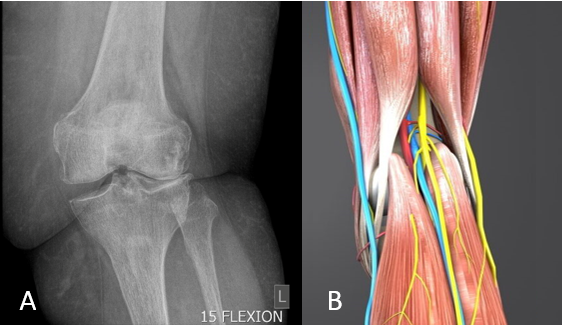
Figure 1. On the left (Image A), a knee radiograph of an individual with obesity shows poor joint alignment, increasing load on the lateral (outer) compartment — a biomechanical setup that can accelerate joint degeneration. On the right (Image B), a posterior view highlights the muscles that support the knee, helping maintain alignment and reduce shear forces across the joint.
Final Thought:
Evidence-based care isn’t just about knowing what works — it’s about delivering it at the right time, in the right way, for the right people. Sometimes, that starts with something as simple as a walk.

Physiotherapist