Pulley injuries in rock climbers: What are pulley injuries and what to do about it?
Injuries to the flexor tendon pulleys in the fingers are common amongst rock climbers. Climbing is one of the only activities that puts an incredible amount of strain on these structures! If you’ve injured your finger climbing, there is a strong chance it could be a pulley injury.
What are pulleys?
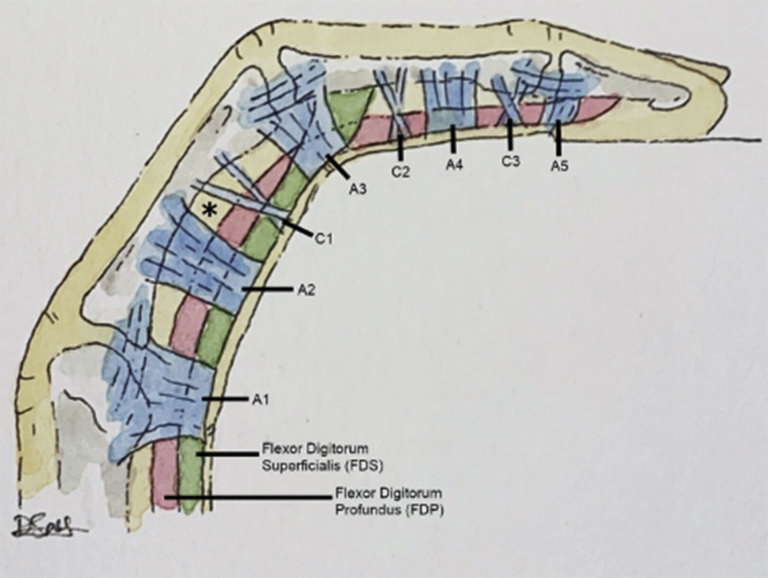
Pulleys are strong bands of fibrous tissue in the fingers where the flexor tendons run through. Each finger has 5 main pulleys (A1-5) and 3 cruciate pulleys (C1-3) (not commonly injured). The A2 and A4 pulleys are most commonly injured.
Function?
Pulleys hold the flexor tendons of the finger close to the bone, so that when we bend our finger, the tendon doesn’t lift. These function like eyelets on a fishing rod, keeping the line close when it’s under tension.
How does climbing injury pulleys?
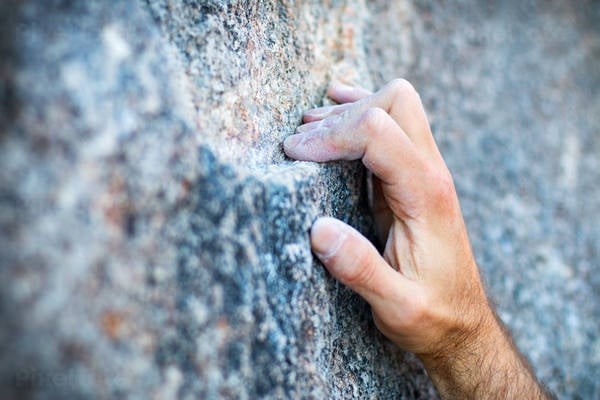
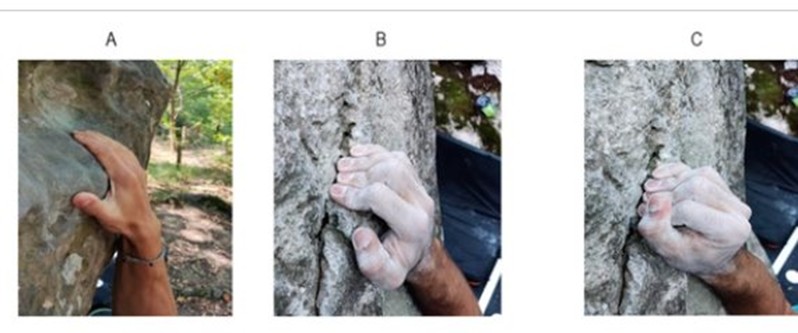
During rock climbing and bouldering, as we grip smaller holds the pulleys are put under more strain. The hand position where the flexor tendons and pulleys are under most pressure is called a ‘crimp grip’. In this position, the proximal joint (PIP) of the finger is flexed to 90 degrees or more, whilst the most distal joint (DIP) is hyperextended. The crimp grip is useful for allowing us to grip onto small ledges (figure C). However, it’s also the position where the most injuries occur.
Typically, climbers will report injuring their finger whilst moving to a small hold with the fingers in a crimp position. Injury can also happen if the finger is loaded suddenly due to a foot slip.
Signs and symptoms
With a pulley injury, climbers usually report a moment of strain or sometimes a ‘pop’ sensation in the finger. Pain will be located on the palm side of the finger. Typically, there will be more pain when trying to grip in crimp positions (Figure C) or apply resistance to the injured finger. Depending on the extent of the injury, there may be less pain in an open hand/ Sloper grip position (figure A). In this position, the fingers aren’t as flexed and therefore there’s less strain on the finger.
Swelling and tendon bowstringing (where the tendon is visibly bulging) aren’t always present in an injury, so it’s important not to be guided by these factors alone.
Management
The first thing is– if the pattern of injury or symptoms fit, then you can be suspicious of a pulley injury. In this case – it’s best to stop climbing and get it checked out by a physio who has a special interest in hand injuries.
You can gently keep the finger moving within a comfortable range of motion as this doesn’t put significant strain on the pulleys. You should avoid excessive gripping and activities that strain the finger.
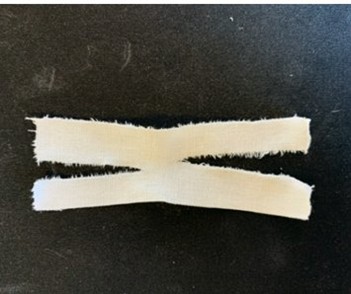
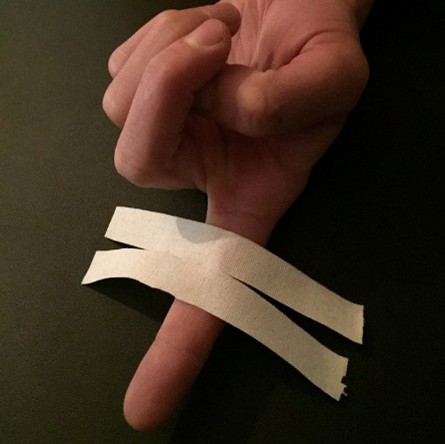
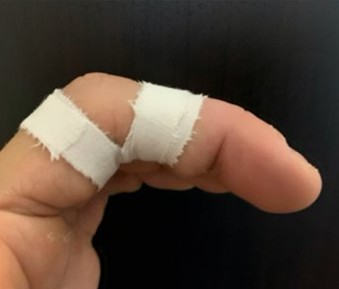
Whilst you’re waiting to see a physio, you can tape your finger using an H-Tape method (pictured below). This will support the injured pulley by pushing the tendon down towards the finger bone and can help reduce the strain with daily activities. Depending on the grade of injury and advice from your physio, H-taping may be used as part of your rehab when returning to climbing.
Generally, a physio may send you for an ultrasound of the finger if they are suspicious of moderate- higher grade pulley injury, or if they suspect multiple pulley injuries. An Ultrasound may give a better idea of the extent of the injury and can help determine how long it will take to return to climbing. It’s good news that surgical repair is usually only reserved for if there are multiple pulley ruptures.
How long until I return to climbing?
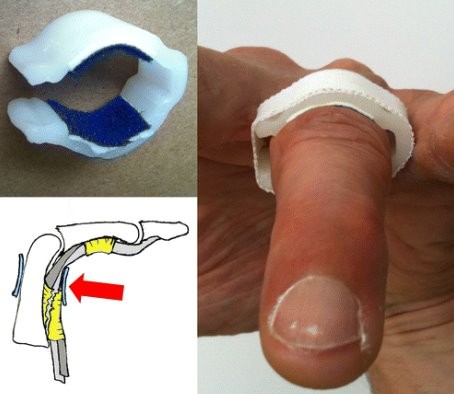
Lower grade injuries may need 2-4 weeks to rest from climbing. Whilst higher grade injuries may need 6-8 weeks of rest before returning to climbing. Depending on the grade of injury and severity of symptoms, your therapist may recommend splinting the finger using a thermoplastic pulley ring splint. (Figure D).
Exercises
Pulley injuries need specific strengthening exercises. It’s important that this is introduced at the right time so that you don’t risk delaying healing or further injury. With help from your physio, you will start range of movement and gripping exercises. This will normally include exercises using a portable ‘hang board’. With guidance you’ll progress to adding resistance /weight to this and will gradually re-introduce climbing once there is sufficient strength in the finger. A treatment plan should be individualized to you, so it’s important to seek advice from a physio who’s keen to get you back on the wall!
Picture references: Figure 1 and 3: Miro, P. H., vanSonnenberg, E., & Schöffl, V. (2021). Finger flexor pulley injuries in rock climbers. Wilderness and Environmental Medicine, 32(2), 123-134. https://doi.org/10.1016/j.wem.2021.01.011 Figure 2: Bellomo, R. G., Bruni, D., Pantalone, A., & Barbato, C. (2024). Assessing finger flexor pulley injuries in climbers: A comprehensive review of clinical and functional testing methods. Applied Sciences, 14(19), 9113.https://doi.org/10.3390/app14199113 Figure 4: Schneeberger, M. & Schweizer, A. (2016). Pulley ruptures in rock climbers: Outcome of conservative treatment with the pulley-protection splint — a series of 47 cases. Wilderness & Environmental Medicine, 27(2), 211–218.https://doi.org/10.1016/j.wem.2015.12.017

Physiotherapist